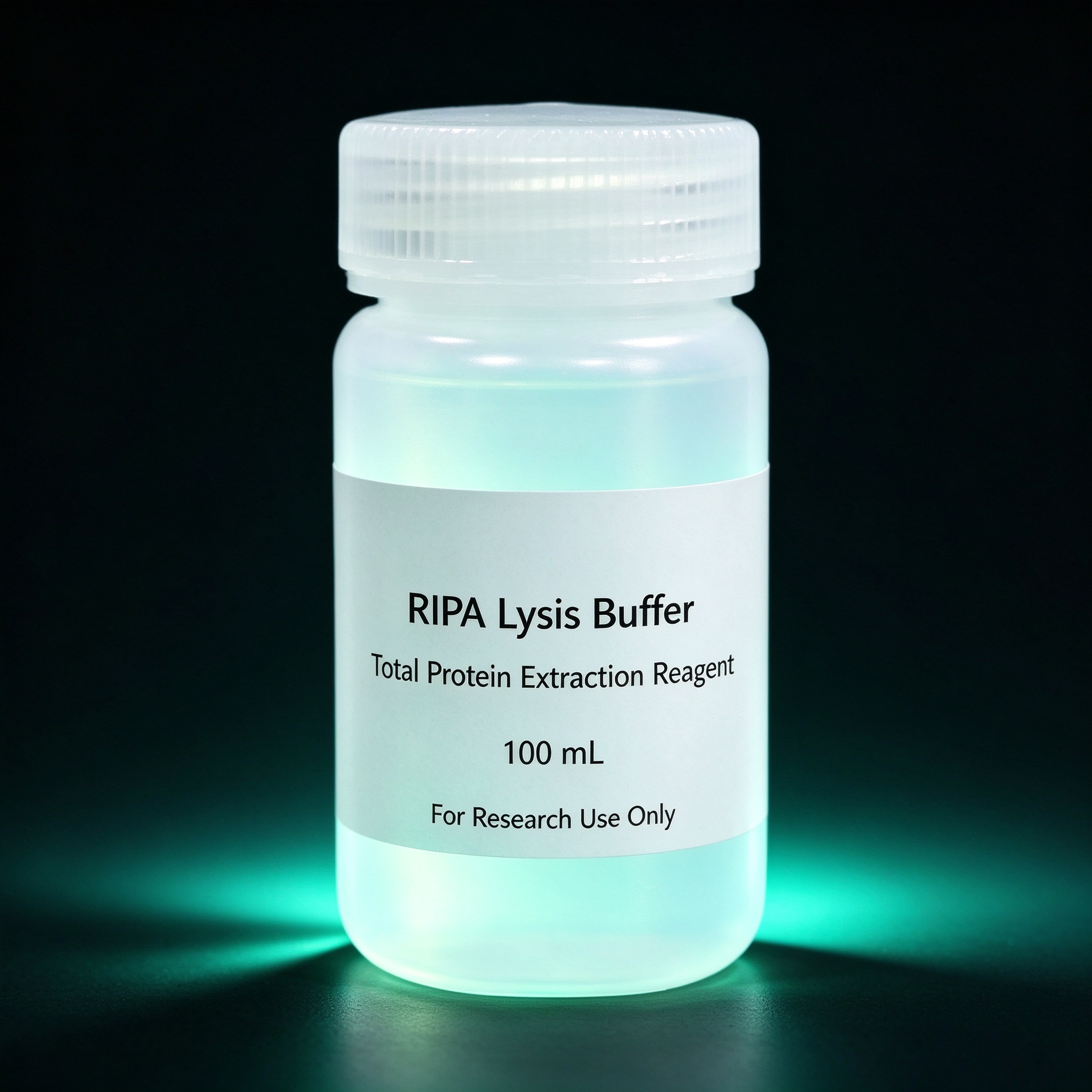
RIPA Lysis Buffer — Total Protein Extraction Reagent
Ready-to-use RIPA buffer with built-in protease and phosphatase inhibitors for fast total protein extraction from cells and tissues — Western blot, IP/co-IP, PAGE and ELISA ready. Strong / Mild / Weak strengths, RUO.
Catalog no. RIPA-S/M/L-100 mL; RIPA-SET-3 x 50 mL · Ships with certificate of analysis
For Research Use OnlyOverview
At a Glance
Ready-to-use RIPA lysis buffer for rapid total protein extraction from cultured cells and tissues. A balanced mixed-detergent system — 50 mM Tris (pH 7.4), 150 mM NaCl, 1% NP-40, 0.5% sodium deoxycholate, 0.1% SDS — disrupts cells on contact, while built-in protease and phosphatase inhibitors (sodium orthovanadate, sodium fluoride, EDTA, leupeptin and others) preserve target proteins and phosphorylation modifications. Spin, collect the supernatant, and go straight to Western blot, IP / co-IP, PAGE or ELISA.
Key Features
- Seconds-fast lysis: cells disrupt within 1–2 seconds of contact — no sonication needed
- Protein-protecting formulation: the built-in protease + phosphatase inhibitor system preserves targets and phosphorylation states during lysis
- Three strength options plus a Complete format: match lysis stringency to your sample; the Complete format adds a de-viscosity solubilizer that eliminates stringy lysate and raises typical protein yield by ~5–25%
- Broad sample compatibility: animal and plant cells, tissues, fungi and bacteria
- High-throughput friendly: the whole workflow is pipette-and-spin — no specialized equipment
Strength Options
| Strength | Character |
|---|---|
| Strong | Highest detergent concentration |
| Mild (standard) | Balanced — the everyday choice |
| Weak | Gentlest |
Pack Sizes
| Pack | Content |
|---|---|
| Single bottle | 100 mL — choose one strength |
| Trio set | 50 mL each of Strong / Mild / Weak |
A Complete format (standard buffer plus de-viscosity solubilizer — no flocculent sticky lysate, ~5–25% higher yield) is available on request.
Specifications
| Parameter | Specification |
|---|---|
| Base formulation | 50 mM Tris (pH 7.4), 150 mM NaCl, 1% NP-40, 0.5% sodium deoxycholate, 0.1% SDS |
| Built-in inhibitors | Sodium orthovanadate, sodium fluoride, EDTA, leupeptin and others |
| Recommended add-on | PMSF to 1 mM final concentration, or a protease / phosphatase inhibitor cocktail, added immediately before use |
| Usage — cells | 150–250 µL per well of a 6-well plate |
| Usage — tissue | 150–250 µL per 20 mg tissue |
| Operating temperature | On ice or at 4 C |
| Clarification spin | 10,000–14,000 x g, 3–5 min, collect supernatant |
| Typical protein yield | ~2–5 mg/mL from 1 million mammalian cells |
| Protein quantification | BCA assay — Bradford is NOT compatible (detergents interfere) |
| Storage | -20 C, 1 year; aliquot to avoid repeated freeze-thaw |
| Intended use | For Research Use Only |
Protocol (Short)
- 1. Prepare: thaw and mix; add PMSF (1 mM final) or an inhibitor cocktail immediately before use
- 2. Lyse: adherent cells — aspirate medium, rinse once with PBS, add 150–250 µL per well and pipette briefly (lysis completes within seconds of contact). Tissue — mince, add 150–250 µL per 20 mg, homogenize or grind
- 3. Incubate on ice. With the Complete format, sticky viscosity typically disappears within 1–2 minutes
- 4. Clarify: spin at 10,000–14,000 x g for 3–5 min, take the supernatant and proceed to Western blot, IP / co-IP, PAGE or ELISA
Applications
- Total protein extraction from cells and tissues ahead of Western blot and PAGE
- Sample preparation for immunoprecipitation (IP), co-IP and ELISA
- Downstream expression validation after transfection or LNP delivery — pairs naturally with our Universal Lipid-Based Transfection Reagent and the CCK-8 Viability Assay: transfect, check viability, lyse, blot
- Lysis of animal, plant, fungal and bacterial samples
- Phosphorylated-protein and subcellular-fraction studies (select inhibitor variants per inquiry)
Handling Notes
- PMSF is not included and must be added fresh. PMSF degrades rapidly in aqueous solution — add immediately before lysis; never store pre-mixed.
- Do not quantify RIPA lysates with the Bradford method — the detergents interfere. Use a BCA assay instead.
- Aliquot on first thaw and avoid repeated freeze-thaw cycles; keep the entire workflow on ice or at 4 C.
Research Use Only
For Research Use Only. Not for clinical or diagnostic use.
Ordering & Documentation
Available strengths, pack sizes, the Complete format, inhibitor variants, COA, MSDS, ISO documentation, FOB pricing, MOQ and lead time are confirmed per inquiry: Send us an inquiry
| Product | RIPA Lysis Buffer — Total Protein Extraction Reagent |
|---|---|
| Catalog no. | RIPA-S/M/L-100 mL; RIPA-SET-3 x 50 mL |
| Category | QC & Analysis |
| Documentation | Certificate of analysis provided with every lot |
| Intended use | For Research Use Only (RUO). Not for diagnostic or therapeutic use. |
Related products
RNA-LNP Encapsulation Efficiency Assay Kit (RiboGreen-based)
Plate-based fluorescence assay for RNA encapsulation efficiency in LNP formulations — total vs. free RNA in 30–60 minutes on any standard fluorescence microplate reader.
Automated CGE-LIF Nucleic Acid Analyzer (400 Advance)
Benchtop capillary electrophoresis system with LED-induced fluorescence detection — RNA/DNA fragment size, concentration and integrity from 1 µL of sample, in minutes.
CE Cartridge Kits (S1 / R1 Series)
Ready-to-use single-use cartridges for the 400 Advance CGE-LIF system — 800 runs per cartridge, 10–50,000 bp, no gel preparation.
Get a quote for RIPA Lysis Buffer — Total Protein Extraction Reagent
Specs, pricing, lead time and shipping options — usually within one business day.